
Coaching Letter #234
Scaling, part the fourth

Hi, I hope you’re doing well. Thank you for subscribing to the Coaching Letter. You rock. Thank you for the responses to the posts on scaling—they have been super useful. Dina, this is your response. Marta, I’m really grateful for your information about failure modes and you’ll see those in the next Coaching Letter… This Coaching Letter continues the theme of scaling (#231, #222, #233); this time, what does it mean to scale something that is deeply human, tacit, adaptive, and context-dependent without reducing it to a script that, stripped of nuance, leads to the replication of form without attention to function on the one hand, or romanticizing it as unique and ineffable? I know that the clichés of squaring circles and threading needles are so, well, cliché, but that’s what we’re going to try to do.
Why is teaching so difficult to scale in the first place? Because teaching contains enormous amounts of tacit knowledge. What is tacit knowledge? Well, interestingly enough, my doctoral dissertation was about tacit knowledge, so you can read that if you really want to go deep. Tacit knowledge is what we know that we either don’t know we know, or can’t express, or haven’t codified yet—or some combination of the three.
Dina (mentioned above) is a 4th grade teacher and wrote to me about issues of scaling:
“My Aunt Clara came from Italy as a teenager and lived in Schenectady. She made the most amazing pepper cookies. One day I went to learn how to make them. She was ninety years old and had been making pepper cookies for 70 years. Basically she dumped flour from a sack into her specific large bowl used for pepper cookies, (one of which I did not own so could not gauge the amount of flour the same way) added oil and mixed it with her hand. No measuring. She pushed my hand in the dough and said, “it should feel like this”. Then she rolled and shaped the dough into a bow shape so quickly I had to ask her to slow down. She couldn’t do it. Her hands did it automatically and she was too much of an expert to teach me.
Teaching is like this too. When I first started I was told to observe an expert teacher to get tips on behavior management. It was not helpful. Her students just did what they were supposed to do. I couldn’t see or hear anything to help me with my class.”
I think we can all relate to this. I’ve been telling the story a lot lately of starting my third year as a teacher, and being totally taken aback by the difference in my classes—kids actually did what I told them to do. I have no idea what I was doing differently, or how I learned to do those things; all I know is that I had, almost entirely through experience, learned stuff without realizing I was learning it about how to manage a classroom. Tacit knowledge, then, is the knowledge embedded in experience, judgment, perception, and practice that people use effectively even when they cannot fully articulate how they are using it. It is valuable, invaluable (aka priceless), and a major signal of expertise. It is frequently indistinguishable from intuition. It is what connects experience to expertise. Tacit knowledge has been the subject of study by several remarkable scholars and practitioners, including Daniel Kahneman, Gary Klein, Harry Collins, and many more.
However, just because a profession, as practiced by its best and brightest, is replete with tacit knowledge, does not make it an art.
Sorry to have to break that to you.
Teaching is not an art, at least not in the way that people usually mean it. With an artist, what we value is what is unique about them: their voice, their point of view, their social commentary, their aesthetic, their technique, their talent, their originality. The purpose is expression of one or more of these things to elicit a personal emotional or intellectual response—or just to be beautiful.
Teaching is not like that. Teachers are more like surgeons, air traffic controllers, or lawyers: technical skill, judgment under uncertainty, adaptation, shared expertise, tacit knowledge, pattern recognition, situational awareness, and goals that involve life-changing outcomes. These things matter. And, in these other professions, there is shared understanding that there are practices that are more promising than others in their likelihood of achieving desired results—in many cases these practices are non-negotiable to the point that you can lose your license to practice if you don’t adhere to them.
You know, I read a lot of authors, I read poetry, I go to art museums, I listen to music. These artists make my life better, richer, and sometimes even bearable. But I wouldn’t say that they have materially changed my life. But I can name several educators who have. We talk about the art of teaching like that’s the goal, but, no disrespect to artists, that undersells teaching.
So when we think about scaling teaching, we have to reject two bad interpretations of what teaching is, simultaneously. Bad interpretation #1: Teaching is purely technical, and therefore the effectiveness of teaching can be scaled through scripts, checklists, and what Collins would call mimetic or mimeomorphic action—watching the experienced teacher down the hall and copying her won’t work (as Dina, above, knows well). Bad interpretation #2: Teaching is an art, and therefore teaching cannot be codified, cannot be improved through collective action, and cannot be scaled (because, as List points out, you can’t scale people).
Just because a profession is replete with tacit knowledge does not make it unknowable, ineffable, or unscalable.
The existence of uncertainty does not mean expertise is impossible; it means expertise operates probabilistically rather than mechanically. Nate Silver, most famous for his election forecasts, has written a couple of books, and the more recent one is about the people who are comfortable living and operating in a high-risk, high-reward world, which he refers to The River. It’s an odd book, and difficult to quote from, but here’s a really useful way of thinking about the space between purely technical and completely unknowable:
The world may or not be inherently random, but between chaos theory and a relative ignorance, many important phenomena are highly uncertain in practice, so we gather data, craft it into what we call reference classes, formulate hypotheses and test them, all to figure out what events are relatively more predictable and relatively less so.
If you think teaching is an art, and you have a provably effective teacher, then you are out of luck when it comes to scaling because, as List points out, you can’t scale people. Scaling that amazing teacher is like scaling Steph Curry or Frederick Douglass or Monet.
Scaling effective teaching, then, requires that we… well, there’s a long and detailed list of all the things you should do, but what will fit here is a reprise of previous writing, and renewed emphasis of Meadows’ point that the highest leverage place to intervene in a system is the mental models that allow the system to self-propagate:
You should create a shared understanding of what equitable and ambitious instruction looks like, based on what the research says about student learning and what it takes to maintain access to cognitively demanding work for all students [we wrote a book to help you with that];
You should identify the places where these powerful practices are already happening in your system—these are sometimes thought of as early adopters, but time is not the discriminator, depth is; we refer to them as positive outliers or bright spots;
You should codify these practices—we call them recipes—and ask teams of teachers to study, adapt, refine, and improve them, collectively;
You should nurture and leverage the people in your system who figure out a way to take on this work [“doubling Sarahs”];
You should do all this in service of changing mental models [two solid CLs about mental models: #184 and #92]: people’s beliefs about what students are capable of, what counts as equitable and adaptive instruction [read the book!,] the role of teacher teams in testing and refining practice, the practice architectures required to support ambitious teaching, and the role of leadership in creating the conditions under which better forms of teaching and learning can emerge. Because every system is perfectly designed to get the results it gets, blaming individuals for outcomes generated by the larger system is, in most cases, an extraordinarily low-leverage activity.
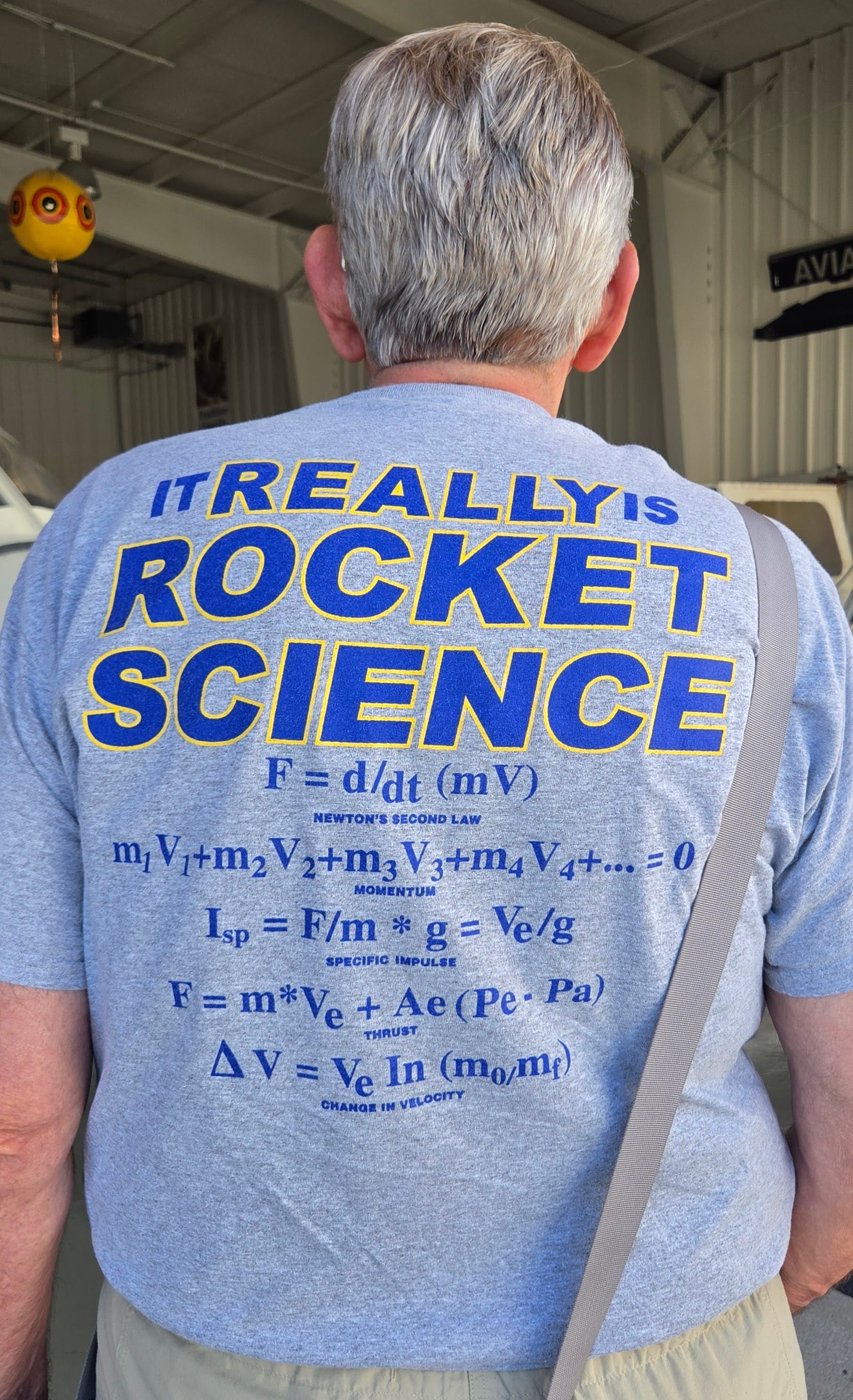
Teaching is fantastically difficult to do well. As I like to say to people—it’s not rocket science; it’s much, much harder. Teaching is difficult to scale because expertise is substantially tacit, but improvement is still possible if we create structures that make expert practice increasingly visible, discussable, testable, and learnable.
Shout-out to my husband for allowing me to take the picture at the top of this Coaching Letter, and shout-out to Embry-Riddle for educating real rocket scientists, including my son. And I realize that if I had been really slick, I would have sent out this Coaching Letter during Teacher Appreciation Week, because it is nothing if not an appreciation of the teaching profession. If you need anything, let me know. Best, Isobel