
Coaching Letter #238
An apology to high school teachers

TL;DR: This Coaching Letter is an apology for assuming that high school teachers are difficult. The first year of the HS NIC taught me how wrong I was. People do not automatically resist change because they are stubborn or set in their ways. They make predictions about what will happen next based on their priors. I have argued for years that behavior is shaped by context, but I failed to apply that lesson to working with high school teachers. I anticipated that they would be hard to work with, rather than remembering that my own grumpiness as a high school teacher was a reaction to years of vague PD, shifting initiatives, and professional judgment pretending to be support. When high school teachers are offered ideas that resonate, concrete ways to try them, and a developmental rather than judgmental environment, they are thoughtful, committed, honest, and generous learners. The problem was never high school teachers. Expectations about how people will respond is based on a system that is generating that behavior.
About 15 years ago there was a piece on NPR that created quite a stir. It was called “What Vietnam Taught Us About Breaking Bad Habits,” about research that was done by Lee Robins in the 1970s. What she found was that a large number of U.S. enlisted men used heroin or opium in Vietnam, and about 20% showed symptoms of dependence. But after returning to the U.S., continued dependence was rare. A later review summarizes Robins’s findings this way: 34% used heroin in Vietnam; 20% had symptoms of dependence; in the first year back in the U.S., only 1% became re-addicted to heroin, though 10% tried heroin again. This last statistic—that only 1% became re-addicted to heroin—was thought to be an unbelievable figure, because typically when heroin addicts were treated for addiction, relapse rates were more like 90%. It didn’t seem possible that people who were addicts when they were soldiers in one part of the world could be addicts no longer when they returned home. And that, as I remember, is what caused the stir—even though the NPR piece reported the study as being true, it still seemed unbelievable.
But 15 years later, a lot more about how behavior and the environment are tied together is generally known and accepted. I think people now know that if you want to get fit, you should find a community of people who do stuff that supports that goal, like hiking or swimming or lifting weights. The techniques for behavior change that James Clear writes about in Atomic Habits—maybe a third of those have to do with manipulating the environment? There’s a very good post on environment design on his website. And I have written about the importance of environment in shaping behavior—one of my favorite studies is The Good Samaritan, showing that even divinity students are not so divine when under time pressure (you can read a version of it in CL #224).
That same Coaching Letter, #224, ends with this exhortation:
So all I’m asking is that you don’t accept as inevitable the idea that people will resist change, because that’s a weak theory and absolves leaders of the responsibility of ensuring that people are more influenced by the conditions they work in than their “mindset”.
It’s a very solid Coaching Letter, but I didn’t appreciate at the time how much it applies to me personally. Ugh. In particular, this CL—the one you are reading now—is an apology to high school teachers, because I did not realize the extent to which I was operating under the assumption that their actions—behavior and speech—are a reflection of them as people and not the situation in which they work. I’m sorry.
I understand how it happens—I know something of what I speak. High school teachers can be cranky—I worked with many when I was a high school teacher, and (unsurprisingly, I know) I was a cranky high school teacher. We were asked to pay attention to so many things, many of them felt completely irrelevant to the basic work of teaching kids—OMG, there were so many PDs on so many different things that one time I tried to make a list of them all and gave up after I’d filled a page in my notebook—many of which I doubt the people reading this Coaching Letter will even have heard of but were very in vogue for a while—4MAT training, anyone? Importantly, I never saw myself as difficult, I saw the stuff that we dealt with as stupid. But I think I forgot that, along the way and through the years.
This, by the way, is a well-documented finding in social psychology. It is known as the fundamental attribution error (FAE): our tendency to attribute other people’s behavior to their character while explaining our own behavior in terms of the situation. When we do something great, it’s because we’re great (“I totally knocked that out of the park!”), but when we do something poorly, we point to the circumstances we were dealing with (“My boss didn’t give me enough time to do a thorough job”). The circumstances argument may be correct, but then the circumstances should also get the credit when things go well, but somehow we always forget that part.
But when someone else behaves badly, we reverse the logic. We conclude that they are lazy, rude, incompetent, or difficult, rather than asking what features of the situation might have produced that behavior.
When Richard and I first wrote the prospectus for the HS NIC, there was language in there that was on the face of it fairly neutral: “the high school is a complex organization, and improvement in high school classrooms does not typically follow the same paths that seem to work in elementary schools.” But when high school teachers saw this, the feedback we got was that they saw this as code for “high school teachers are difficult to work with and don’t want to change”. Which was not actually the intent, but I admit now that that was my underlying worry. (Also, significantly, when I first heard that, I thought “Richard wrote that part”—which, if you have been paying attention so far, you will recognize as the FAE at work—although it is true that he wrote that part.)
And then, during the first year of the HS NIC, Andrew and I learned that, despite the common stereotypes, if you provide HS teachers with ideas that resonate with them, and concrete suggestions for how to enact them, and ask them to experiment, and take their feedback seriously rather than judge them, they are thoughtful, committed, and wonderful people who are honest and transparent about their work, their struggles, and what they are learning.
So, how does this happen? People’s expectations of how others behave is based on their Bayesian priors, which is a reference to the Reverend Thomas Bayes, an English minister and thinker who came up with the idea that—and you should know that this is the non-technical version of this—you can use existing evidence to make predictions about the future when not all the variables are known. (Making predictions about the future when not all the variables are known is part of what is known as “decision-making under uncertainty”, which is what educators are doing ALL THE TIME.)
All the statistics that I remember from school involved known variables—what is the probability of drawing a white marble out of a bag of 50 marbles if only 5 of them are white and the rest are black—but most of the time we are making predictions based on what is either unknown, partially known, or unknowable. So there’s the math of that, which I don’t understand, but there is also the epistemology—how do you know? And Bayes gives us a theory of how a rational person should form and revise beliefs.
Obviously, humans do not have computers for brains, and so the idea that they are going to execute a complex statistical algorithm to analyze priors and update them in the face of new evidence to make a decision is obviously not going to happen. The cognitive shortcut that is the nearest equivalent to that is called a heuristic, or a rule of thumb. Many heuristics are extremely useful—my coaching experience has given me many that I use all the time—and they represent adaptive approximations of Bayesian reasoning.
But humans are not perfect Bayesians, so they make mistakes. For example, they tend to make judgments about people based too much on first impressions—if someone you’ve never met before is late, for example, you are quite likely to form an impression that they are lackadaisical or disrespectful, when a pure Bayesian would ask: How common is this behavior among perfectly conscientious people? (Pretty common! Traffic, childcare, navigation mistakes, emergencies, etc.) How diagnostic is this evidence? (Is being late once actually strong evidence of disrespect?) How much weight should I give this one observation considering that I really don’t know much about this person?
And we develop associations that tell us what we think will happen, based on our priors, but we don’t necessarily think hard enough about why things happened—which takes us back to our normal human bias about explanations based on person rather than environment (back to The Good Samaritan). Which leads us to underestimate how much a change in conditions can change a result in behavior. Which brings me back to high school teachers.
Expectations about how people will respond is based on a system that is generating that behavior.
People do not simply resist change. They make predictions about what will happen next, based on the environments they have experienced. My experience as a high school teacher was: New school year = new initiative → vague PD + amorphous expectations (“just try something!”) → private struggle to figure out what it meant and what I was supposed to do with it + suspicion that I was being silently judged → abandonment as soon as I thought no one was looking. With us, teachers frequently ask the question “Will I get dinged for that?” The technical answer to that, which they know, is no, the chances of this ever showing up on anyone’s evaluation ever are vanishingly small. But that’s not what’s really going on. In Bayesian terms, the teacher is not calculating the odds of an actual unsatisfactory rating. They are voicing their prediction that this will turn into yet another episode of professional judgment pretending to be support.
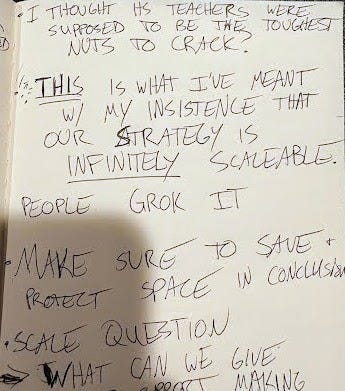
I feel particularly bad because I should have known better. I have written extensively about person-situation and fundamental attribution error, and I co-authored a book that has a chapter on the psychology of change. I could quote myself but somehow that makes it all the more embarrassing. I walked into the HS NIC with the expectation that we were going to be successful despite the difficult nature of high school teachers. Andrew was much more confident than I was that the HS NIC would be a success, and he gloated to me about that yesterday on the phone (“I told you it was infinitely scaleable!”). But he also was not carrying the same priors as me, therefore his mental models and expectations were different.
I used to think that all the skepticism about the findings of the Vietnam addiction study had a lot to do with the fact that the lead researcher was a woman, and I still think that probably had something to do with it. But now I realize that mostly it was unbelievable because it flew in the face of all the priors of doctors and policy experts and sociologists who read it. This is why science fiction is so important, and living in other countries. They show you not necessarily that there is a better way of doing things, but that there is a different way of doing things. They both challenge your mental model and show you that you have a mental model.
The answer to “how do you know?” is very often that this is your prior experience, and we all need to get better at understanding that there could be a different system out there that could generate different outcomes. Andrew wrote the note in the photo to me at the top of his notebook while we were in Guilford in April. The teacher who was the most reflective and transparent and articulate—the one who will always represent to me the spirit that moved Andrew’s question—died suddenly not long after our last meeting, which I am very sad about because he was so thoughtful and reflective and humble and I liked him very much. I am grateful for the opportunity that he gave me to confront my own inability to question my own thinking, and I intend to grow from it. I will be better, I promise.
I think it also bears emphasizing that all this leaves me super excited about the work moving forward. My insight into my own inability to realize that it’s the system that’s producing the behavior is actually empowering: We are not at the mercy of cranky personalities; we have the power to shift to a different system that operates with different beliefs and principles and produces different reactions. This is huge.
Did I mention how grateful I am to all the teachers we work with who have taught us so much? If you need anything, I’m all yours. Best, Isobel