
Coaching Letter #228
The Strait of Hormuz is a bottleneck

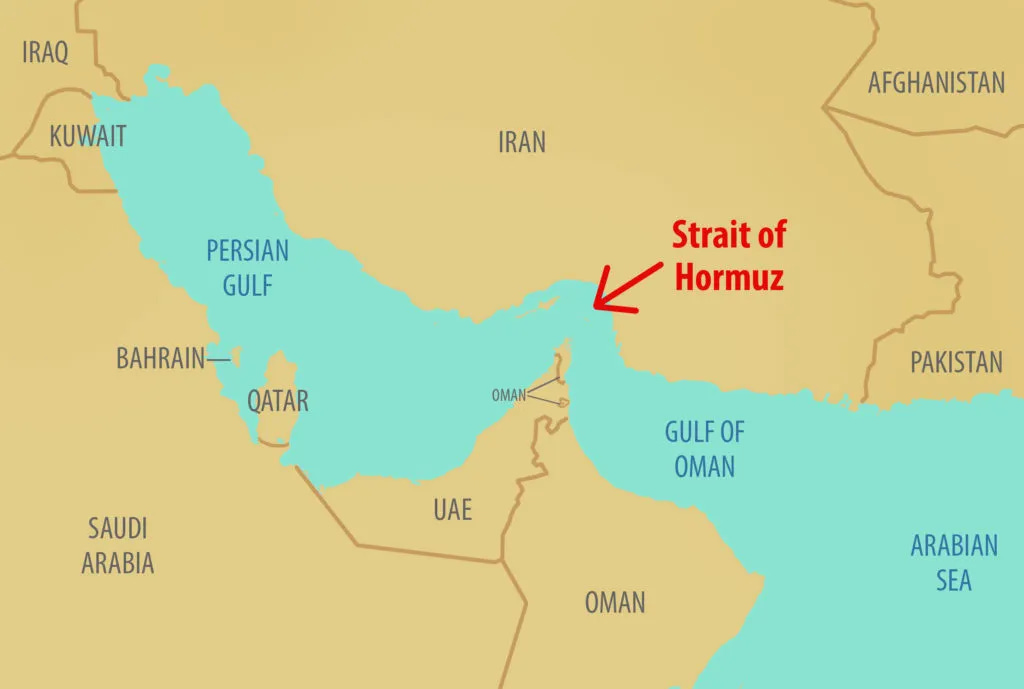
Friends, thank you for subscribing to the Coaching Letter—you rock. I’ve been working for a long time on a Coaching Letter to do with education and the theory of constraints—it’s taken me a long time because simultaneously we’ve been working on a book project and a couple of articles and I also have a day job. Last Coaching Letter—#227—was, I thought, a very clever tee-up to a more technical letter about constraints (AKA bottlenecks) in teaching and learning; I wrote about rowing, which is something I happen to know quite a lot about.
And then, out of the blue, the United States starts bombing Iran, and the news is full of discussion of bottlenecks. The salient bottleneck right now is the Strait of Hormuz. The strait is a very narrow passage between Oman and Iran that connects the Persian Gulf to the ocean. (I went to school in Kuwait for a few years, and learned a lot about the history and geography of the Middle East, including, of course, lots about the oil industry. Funnily enough, in our textbooks, the Persian Gulf was labeled the Arabian Gulf.)
Approximately 20% of the world’s oil supply moves through the strait, on its way from the oil refineries of the Middle East to markets across the world, including of course the US. The shipping lanes are only about 2 miles wide in each direction! So you have a massive flow of fuel passing through a tiny geographic constraint. It’s a classic example of a bottleneck.
Eliyahu Goldratt wrote The Goal, which is a novel about the Theory of Constraints (ToC). Yes, I know, sounds ridiculous, but it’s great—and super useful. The major point is that you can make improvements in all kinds of places in the system, but if you are not addressing a bottleneck—the one place in the system that is holding back the rest of the system—then you are not improving the system overall. In the last Coaching Letter, I used rowing as an example because it’s really clear that you can get fitter (aerobic capacity) and stronger (especially back muscles), but unless you improve your technique, you are not going to row more efficiently or effectively.
Goldratt lays out 5 steps to deal with bottlenecks. Here they are, using the Strait of Hormuz as an example:
Identify the constraint. It’s the Strait of Hormuz. Approximately 20% of the world’s oil supply passes through it, and it is roughly the same width as Long Island Sound. I know, crazy, right?
Exploit the constraint. In other words, use it as efficiently and safely as possible. In practice, this means tightly managed shipping lanes, coordinated tanker traffic (about 60 of those enormous tankers a day, I read), naval patrols to keep the route open. And a large number of organizations are involved in making this work: tanker schedules are built around the passage, producers time shipments to avoid congestion, insurance companies are involved, as are diplomatic efforts—until the US starts bombing Iran.
Subordinate everything else to the constraint. In other words, whatever else you’re doing, you’re going to ensure that your primary focus, the goal that everything else is lined up behind, is protecting and maximizing the flow through the bottleneck.
Elevate the constraint. I wish this was called relieve the constraint—I think elevate is counter-intuitive. But the idea is that you do what you can to reduce the primacy of the bottleneck by getting around it in some way. For example, Saudi Arabia built pipelines to the Red Sea and the United Arab Emirates (UAE) built a pipeline to the Gulf of Oman. In the US, we maintain strategic petroleum reserves, which can be released if our oil supply (through the Strait of Hormuz or some other supply) is threatened. These are all attempts to reduce dependence on the constraint.
Adapt to changing constraints. No one is surprised that the Strait of Hormuz is a bottleneck—it’s not like the geography has changed since the gulf countries started exporting oil on a huge scale in the late 1960s. But let’s say that more pipelines are built, or a massive new oil field is discovered (which does still happen—for example, 13 billion barrels of recoverable oil in Kazakhstan in 2000, but that’s still puny compared to the total capacity of oil in the Middle East, which is about 800 billion barrels). Then the system of oil production and transportation would adapt to whatever new bottleneck emerged—which would still likely be a maritime chokepoint, but could be refining capacity. Oil only becomes economically useful once it passes through the refining process, where crude is turned into gasoline, diesel, jet fuel, petrochemical feedstocks, and so on. (The reason we were in the Middle East in the first place was that my dad was working for a petrochemical company, leading their human resources department.)
There is a great post by Tom Geraghty of the Psych Safety Newsletter (you’re already signed up, right?) on the Theory of Constraints. If you want to read more about the Strait of Hormuz and the current geo-eco-political crisis, see this post by Paul Krugman and this one by Nate Silver—from whom I stole the map at the top of this post—I don’t think he’ll mind. And if you are now fascinated by the topic of oil and its role in world politics and history, there’s a classic book by Daniel Yergin called The Prize, which won a Pulitzer, and an update by Yergin called The Quest. And there’s a book that’s on my list that I haven’t read yet called Chokepoints, by Edward Fishman, about how control of global bottlenecks in finance, shipping, technology, and supply chains is a geopolitical tool.
OK, the plan is that the next Coaching Letter (finally!) will be about bottlenecks in education. Stay tuned! And in the meantime, if there is anything else I can help you with, please don’t hesitate to reach out. Oh, and thank you to everyone who responded to the last Coaching Letter with stories about your own connection to rowing—including someone I’ve been friends with for 30 years whose daughter is a world-class rower and I didn’t know! Please—all feedback welcome. Best, Isobel
I love how you’ve used something so recent and applied it to coaching and education Isobel. It really resonates for someone like me who likes to think about systems. Truly food for thought.
Connecting the bottleneck in the Middle East to education is something I hadn't thought about. I look forward to seeing how you generalize this to our field, Isobel.